
 MCV/DEVELOP News, events, research and jobs from the games industry
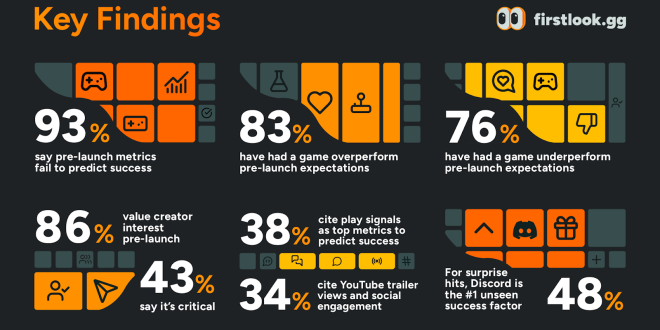
93% of senior AA and AAA studio leaders say they cannot reliably predict whether a game will be a commercial success or failure ahead of launch, despite widespread tracking and analysis of wishlists, trailer views and social engagement metrics.
That’s according to new research from FirstLook, the player relationship platform built for the games industry, which examines the effectiveness of pre-launch marketing signals for PC and console titles. Based on a survey of 250+ senior industry leaders in the US, UK and EU, Signals of Success: The Early Indicators that Predict a Game’s Commercial Performance, finds that although marketers are tracking more metrics than ever, this hasn’t translated into better forecasting of commercial performance.
This is encapsulated by the fact 76% of studios believed they had a hit on their hands based on pre-launch data, only to see the game underperform; and 83% have worried a game looked weak before launch, only for it to exceed commercial expectations.
“Modern game launches are drowning in data,” commented Eden Chen, CEO of FirstLook. “But visibility doesn’t pay the bills. Player behaviour does. When studios misread early signals, they waste marketing budget, misjudge demand and take on real financial risk. The teams that win are not chasing vanity metrics. They measure commitment. Hours played. Retention. Community depth. That is what drives revenue, sharper forecasting and long-term franchise value.”
The report highlights a critical disconnect between what studios track and what they actually trust. Simply: awareness isn’t the same as demand, so top-of-funnel awareness metrics frequently fail to predict outcomes. In titles that turned out to be ‘false positives’ – looking strong pre-launch but failing to convert – the biggest red flag was a reliance on passive visibility signals that masked weak underlying player intent.
When players move from passive awareness to active engagement, confidence shifts dramatically. Studios cite the following as the most commercially meaningful early indicators once players get hands-on with their game: Hours played (41%), Replay rate (30%), Day 1/Day 7 retention (29%). These behavioural metrics consistently outperform raw exposure signals as predictors of commercial performance.
One of the report’s most striking insights concerns the role of community depth. For surprise ‘sleeper hits’ that exceeded expectations, Discord community growth was identified as the #1 unseen success factor, cited by 48% of studios – outranking YouTube views, social engagement, press coverage, and wishlists. Joining and actively participating in a Discord server signals effort and advocacy – making it a far stronger indicator of long-term demand than passive impressions. Yet only 40% of studios currently track their Discord community in a structured way – highlighting a major opportunity for studios launching games in 2026.
![dfgdgdg [Industry news] Fireshine Games Expands Its Successful Portfolio with the Acquisition of Danish Developer Fair Games and Their Multimillion-Selling Game Necesse](https://mcvuk.com/wp-content/uploads/dfgdgdg-310x165.png)
![VIVA Marketing press 2 1 [Event News] VIVA! Games Marketing returns to tackle the biggest challenges facing games marketers](https://mcvuk.com/wp-content/uploads/VIVA-Marketing-press-2-1-310x165.png)
![1662974279280 Copy [Guest post] Keep Game Concept Motion Separate from Gameplay Footage](https://mcvuk.com/wp-content/uploads/1662974279280-Copy-310x165.jpeg)
![97e8fb73 f309 4ff6 b444 c104b821f97c [Industry news] Universally Speaking launches QA Academy](https://mcvuk.com/wp-content/uploads/97e8fb73-f309-4ff6-b444-c104b821f97c-310x165.png)