MCV/DEVELOP News, events, research and jobs from the games industry

Vince Pavey had a chat with Laurent Malville, creative director at People Can Fly, about making their new base-building survival and extraction shooter hybrid game Lost Rift, which is currently in Early Access on Steam.
How do you describe Lost Rift to people when you tell them what you’re working on?
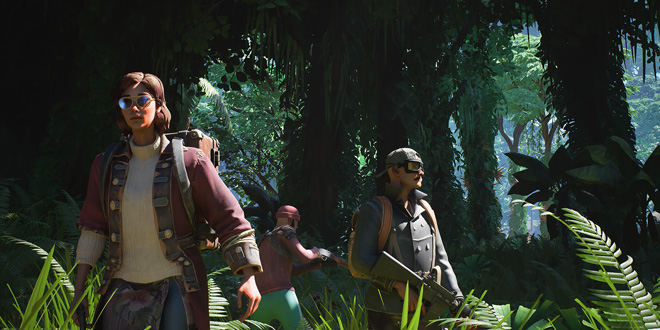
Lost Rift is a new kind of survival game blending PvE and PvPvE. You start as one of the only survivors left after a massive cruise ship travelling through the Bermuda triangle got destroyed by a supernatural storm. You wake up on the beach of a mysterious archipelago alone or with some friends in coop. The game is split into 2 key parts. First, you have your own PvE world that you can explore at your own rhythm. This world is rich in secrets and content, but you will need to venture to other PvPvE expedition islands across the archipelago if you want to retrieve the most precious loot. When you go into an expedition, you will be matched to face-off against other real players who are also trying to survive in this world.
I mostly know you as a developer of really good narrative-driven shooters. What made you decide to combine survival gameplay and base building with extraction shooter scenarios?
The game expands on People Can Fly’s roots as a narrative-driven shooter developer. With Lost Rift, the team saw an opportunity to bring the narrative worldbuilding we’re known for into the survival genre and combine it with deeply emergent, intense combat of an extraction shooter to deliver something new to players. We feel like this fusion of survival, base-building, and extraction mechanics challenges expectations, rewards curiosity, and makes players feel like every decision really matters.

What DNA does Lost Rift have in common with your other games that will make your fans want to pick it up?
Lost Rift is obviously very different from our previous games. It is also the first time we released an Early Access title that we are building alongside the community way before a v1. But, if there is one thing that players should expect that’s in common with previous games, it’s that Lost Rift has visceral action, plus a commitment from our team to deliver quality improvements and new features to our growing community.
What are the progression systems like, and how do the survival and extraction gameplay systems propel each other forward?
We currently have 3 main progression systems: the quests, the loot rarity, and the workbenches. All of these progression systems are typically found in survival games and the quests are actually further separated in two categories. There are main quests that anybody in your coop party can support and progress against, and personal quests that belong to you only.
How hard was it to make the two quite different types of gameplay feel like a cohesive package?
This is something we worked really hard to resolve and we wanted to make sure this blend of gameplay felt natural. We’ve done this through our quest and loot system. In order for players to complete quests on their PvE island, they must go to the PvPvE Western Island to get the necessary loot. This loop that requires you to gather resources across PvE and PvPvE scenarios has proven fun and engaging with some community members already exceeding 200+ hours in-game.
Lost Rift is more graphically intensive than a lot of survival games. How does that affect performance when building settlements, and has it made you make any specific design decisions that you might not have made otherwise?
You’re right, we wanted to make a high-quality and visually diverse game that takes advantage of the latest PC GPUs. The team has made a few design decisions around foliage and textures to optimize performance, but we haven’t needed to make many large compromises to ensure the game runs effectively and we’ve allowed for settings adjustments as needed.
You’re currently in Early Access. How is player feedback being used when it comes to the design roadmap, and how do you prioritise when it comes to requests from people who prefer to be base‑builders or people who consider themselves more into the extraction‑mode?
Player feedback is the single most important and core part of our development process right now. We are looking at every positive and negative review and we have a customer service ticketing system through our Discord, so we are able to address issues or concerns directly with players. We don’t prioritise based on player preferences between PvE or PvPvE experiences. Our team prioritises player feedback based on a mix of factors such as severity of gameplay impact, frequency of concern, and ability to address the feedback from a technical standpoint. This approach was used for all our hotfixes and our first major patch, allowing us to provide updates across all player preferences.
The game currently uses Generative AI for artwork in some areas. Like a lot of gamers, I’m not a fan of that at all. Are there plans to replace that stuff by the full release of the game?
I do understand the discomfort about generative content. Generative AI as a tool allows us to go faster and to focus instead on game mechanics, quality of life features and new developments. We have been using generative AI tools provided with classical development softwares like Adobe Photoshop software to help us go faster specifically with 2D icons. This process allowed us to have usable 2D icons faster, way before the 3D model is completed, and to be able to play the game and test rapidly. As the 3D models got completed, we replaced the 2D icons using the model our artists created. While we rely more on generative AI for new items that don’t have a 3D model yet, there are always several manual tasks that our team is doing per icon before it makes its way into the game.
What’s next up on the update roadmap for Lost Rift?
This is really exciting for us right now to be building Lost Rift with our growing community! We are cooking up a lot of fantastic updates! Some are brand new content and important quality of life features. Some others will develop and expand the narrative lore of this world.
For new content, the team is hard at work right now creating a brand new Expedition map for players to discover. This will give more content to explore to our most dedicated players, while also expanding the world of Lost Rift for existing players and newcomers. This new map will contain new POIs, new enemies and new weapons to discover. We are also working on a gun modding system. This will allow players to fully customize their favourite weapons with the attachments they find in the world.
As I was mentioning, we are also doing a lot of quality of life (QOL) improvements. For example, little things like displaying the health of your equipped armour on the HUD, which will help players visualize faster when they are taking more damage. We are adding a brand new type of chest that will allow players to craft at workbenches without having to transfer resources. Many players have also asked us about being able to retrieve ammo from firearms. It is a great point and we will add that functionality soon. Other QOL updates planned include a fast travel system on Pioneer’s Landing (your PVE world) and solo players will also soon have the ability to revive themselves for a better expedition experience.
We are also working on long term progression systems to develop your character further as you explore the archipelago. This will bring new challenging opportunities and rewards to player’s survivors over time and also always give players progression, even in case of an unsuccessful expedition.
While the core of our game is the unique blend of PvE and PvPvE, we have also been closely watching a specific request from some players in our community about being able to enjoy the game with a PVE-only mode. I can’t confirm anything specific today, but I can say that it is important to us to allow players from different horizons to enjoy our game. We believe we have found an exciting way for PvE-only players who get too stressed by PvP to enjoy our game. We will share more about it through the Early Access phase.


![golden joysticks clair obscur 660x330 1 [From the industry] Winners Announced at the 43rd Golden Joystick Awards](https://mcvuk.com/wp-content/uploads/golden-joysticks-clair-obscur-660x330-1-310x165.png)
![xds img header 1 [From the industry] XDS marks move to the Vancouver Convention Centre with 50% off tickets for first 100 developers](https://mcvuk.com/wp-content/uploads/xds-img-header-1-310x165.jpg)